
How Clients Find a Firm Now - And Why It's Not a Google Search
People increasingly ask an AI assistant for a professional and act on the name it gives. Use of AI to find a local business jumped from 6% to 45% in a single year. Here's how discovery actually works now, and how to be the firm that gets named.
Answer
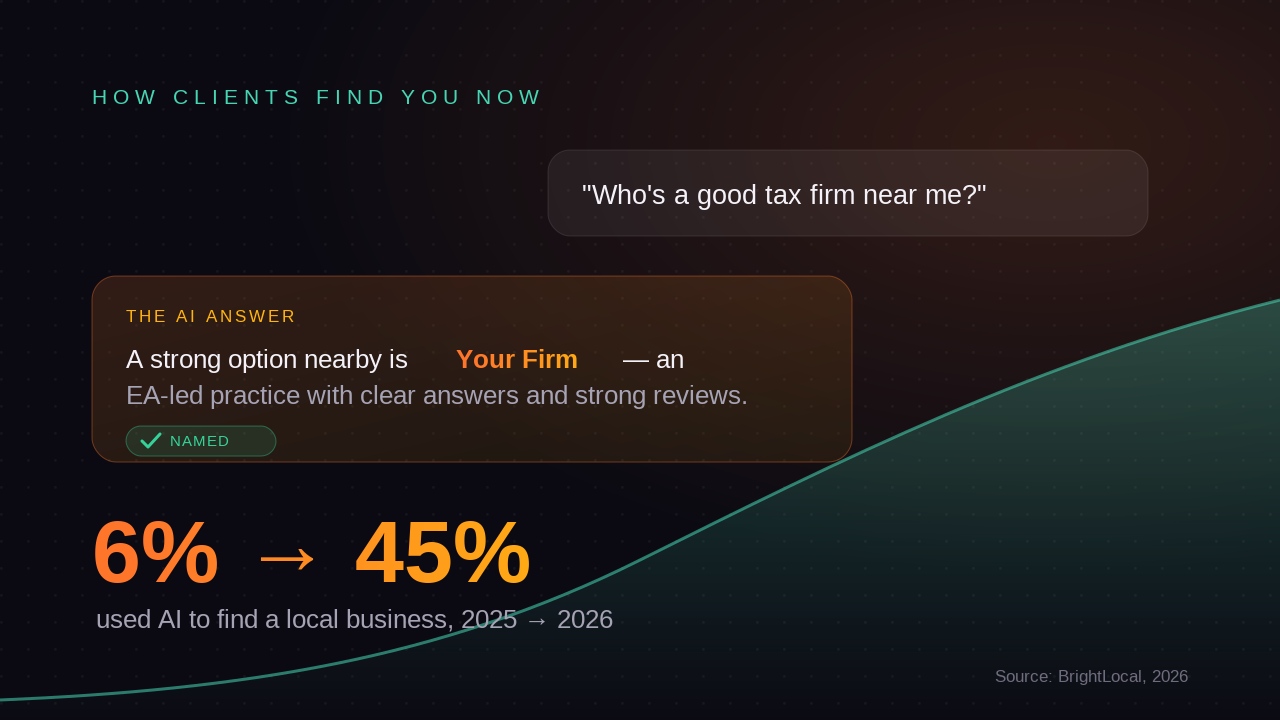
More and more, people don't start at a search box - they ask an AI assistant "who's a good tax firm near me?" and act on the name it gives. In a single year, the share of consumers using AI to find a local business jumped from 6% to 45%, and roughly 42% say they'd use AI to research a professional like an attorney. The practical shift for a firm is this: being found now means being the firm an AI answer names. If the assistant can't confidently identify and recommend you, you're not on the list the client ever sees.
The front door moved
For a decade the path was predictable: a prospect typed a query, scanned a page of links, and clicked. That path still exists, but a fast-growing share of people skip it entirely and just ask - out loud or in a chat window - for a recommendation. The assistant replies with an answer and, when it's useful, a short list of named firms. There's no page two, no ten blue links to work down. There's the name it gives, and everyone else.
6% → 45%
Consumers using AI to find a local business, 2025 to 2026 (BrightLocal)
~42%
Say they'd use an AI assistant to research a professional such as an attorney (industry survey, 2026)
64%
Of 30-to-44-year-olds have already asked AI for a recommendation
What the question actually sounds like
"I got a CP2000 notice - who should I call?" · "Best firm near me for an offer in compromise."
These aren't searches to browse. They're requests for a decision. The prospect is in motion, and they'll act on the firm the assistant names - often without ever visiting a results page.
Why your clients are asking AI, not scrolling
The appeal is obvious once you've done it: instead of reading ten snippets and guessing, you ask a question and get a recommendation with reasons. For high-stakes, research-heavy decisions - exactly the kind a tax or law client faces - that's a relief. They still verify before they hire, but the shortlist is now built by the assistant, from the firms it can identify and trust. Getting onto that shortlist is the whole game.
What it takes to be the name AI gives
An assistant names the firm it can understand and vouch for. A few things decide whether that's you:
Answer the questions clients ask
Plain-language pages that address the real problems - notices, levies, offers in compromise, specific legal matters - give the assistant something accurate to cite when someone asks about exactly that.
Be unmistakably identifiable
Clear, consistent facts - your name, location, services, and credentials, machine-readable and the same everywhere - let the assistant pick you out as one firm, not a fuzzy maybe.
Earn the trust it looks for
Credentials, genuine reviews, and consistent mentions across the web are the signals that move you from "exists" to "worth recommending."
Keep answering, on a steady rhythm
Recognition is built over time. Firms that keep publishing accurate answers to their market's questions stay eligible to be named on every new question; firms that stop fade out of the answer.
Invisible firm vs. cited firm
The gap isn't about who does better work. It's about who the assistant can see.
The invisible firm
Great work. Never named.
Strong service and word-of-mouth, on a site an assistant can't parse. It's never in the answer, and the prospect never learns the firm exists.
The cited firm
Same work. Chosen.
The same service, on a site built to be read - so the assistant names it, with a reason. It gets the call, books the consult, and signs the client.
The honest part
No one can promise an AI will recommend you, and recognition can't be faked - it's earned through accurate answers, real credentials, and consistency over time. What you can control is whether you're eligible to be named: whether an assistant can find you, understand you, and trust you enough to say your name. The front door to your firm has moved. The firms that notice - and make themselves the answer - are the ones getting found.
Q&A
Can I make an AI recommend my firm?
You can't force it, but you can become the kind of source it names: clear, answer-rich, credentialed, and consistent. That's what makes your firm eligible on the questions your clients are already asking.
How do I know if an AI can find me today?
Run a free AI-Visibility Sweep. It checks whether major AI assistants can identify and name your firm, and shows the specific gaps keeping you out of the answer.
Find out if the answer names you
When a client asks an assistant for a firm like yours, does your name come up - or a competitor's? The free AI-Visibility Sweep tells you in about a minute, with the exact fixes to get named. The new front door is already open. Make sure it leads to you.
Put this into practice
See where your firm stands - free
Run a 60-second AI-Visibility Sweep on your site, or grab the free 2026 AEO & Website Playbook for tax firms.